More flowers from the early Paleocene of Patagonia
Sixty-five million years ago, the east coast of Patagonia was much warmer and wetter than it is today. Fossil wood, leaves, and flowers from Chubut Province, Argentina, show that where there is only steppe today, there was once forest.
Among the flowering trees were ancient Cunoniaceae, including Lacinipetalum spectabilum, known from elaborate fossil flowers like the one shown below. The flowers were gently buried in a muddy tidal channel, which preserved the sepals, the delicate fringed petals, and the stamens with their pollen.
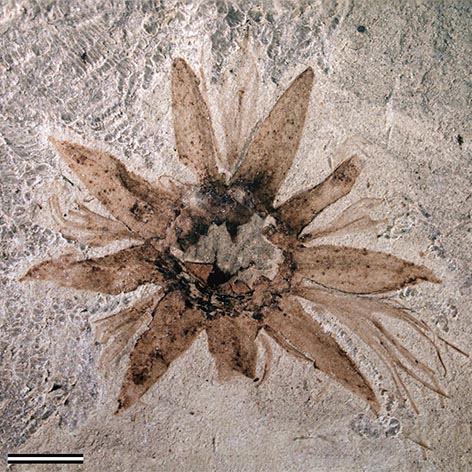
Lacinipetalum is most closely related to the tribe Schizomerieae in the Cunoniaceae, which includes the New South Wales Christmas bush. But it differs in having a fully doubled flower, with 8–10 sepals, 8–10 petals, and 4 carpels, instead of the 4–6 sepals and petals and 2 carpels seen in most living Cunoniaceae. This group no longer grows in South America; today it's found in Australasia and southern Africa.
The fossils are described in Jud et al. 2018, available on my publications page.