Early angiosperm fossils in museum collections
September 15, 2015 (edited November 2026)
The staggering diversity of flowering plants, compared with the relatively low diversity of all other groups of land plants, is one of the most dramatic patterns in plant evolutionary biology, given their geologically recent origin. Long-standing questions such as “What did the earliest flowering plants look like?” might be answered using specimens already held in museum collections.
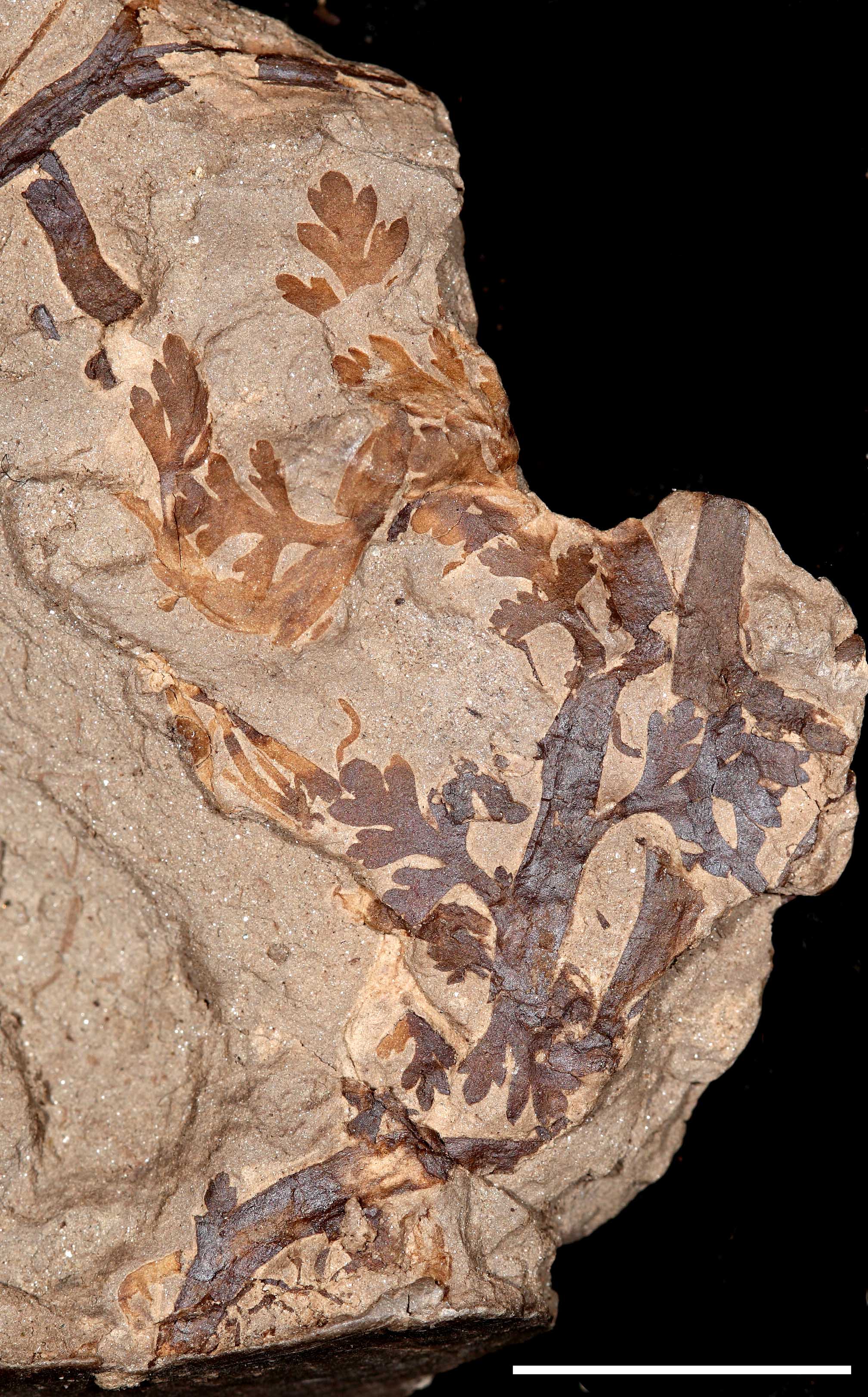
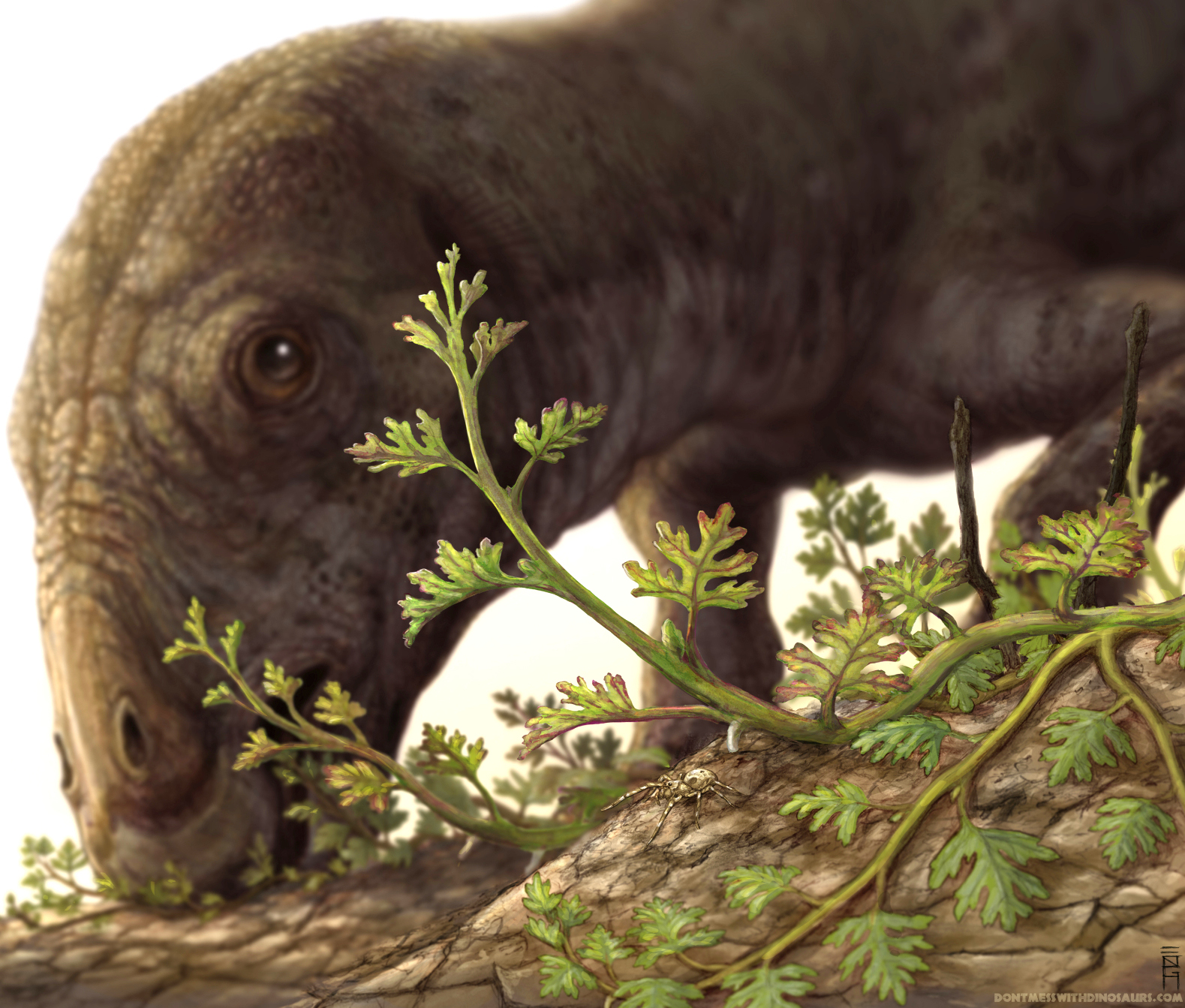
This is Fairlingtonia thyrsopteroides (Jud 2015), a small angiosperm (flowering plant) that grew in Maryland and Virginia approximately 115 million years ago. The scale bar in the bottom right is 1 cm. The first specimens of this species were collected over 135 years ago, but they were misidentified as ferns and given the name Sphenopteris thyrsopteroides (Fontaine 1889). Others have been collected since (Jud 2014), but the misidentification is probably the reason they were overlooked for so long. I discussed the challenge of distinguishing ferns from angiosperms in an earlier paper (Jud and Hickey 2013), which also described a new early angiosperm found in existing collections. Now that these fossils have been recognized as angiosperms, the species has received a new genus name. Below is a reconstruction of the plant by artist Brian Engh, whose work can be found here. The dinosaur is a juvenile Tenontosaurus.
My interpretation is that Fairlingtonia is among the oldest known eudicot angiosperms (eudicots are the largest group of flowering plants, making up about three-quarters of living species, including buttercups, sunflowers, and oaks), but it is also possible that it belongs to a different group and that its eudicot-like leaves are convergent (evolved independently, rather than inherited from a shared ancestor) (Coiro et al. 2020). Because we have attached stems, leaves, and roots, it is among the best-understood early angiosperms in terms of its environment and life history. Unfortunately, we don’t have the flowers yet, but I’m optimistic we will someday.
The plants were very small but locally common. Available evidence suggests they were adapted to colonizing bright, wet microsites (small patches of habitat with their own local conditions); they probably did quite well on fresh soil following floods and fires. This is very different from the “dark and disturbed” or “xerophobic” (dry-avoiding) model of the earliest flowering plants as a whole, which suggests that the ancestors of modern angiosperms were shrubs adapted to wet, shady forest understories (the layer of vegetation beneath the canopy), similar to the modern Amborella trichopoda (Feild et al. 2003, 2004, 2009; Feild and Arens 2007).
Edit: Additional specimens have since been found in the Lower Cretaceous of China (Du et al. 2023). They support the interpretation, of Fairlingtonia as a weedy colonizer of open, wet habitats, and some are preserved with small reproductive structures that might be fruits.
However, these two models aren’t necessarily incompatible. Whereas the earliest angiosperms may have been understory shrubs, most of the diversity of herbaceous (non-woody) angiosperms is found within the derived monocot (grasses, lilies, orchids, palms, and their relatives) and eudicot clades (groups made up of a common ancestor and all its descendants), and the ancestors of these plants likely got their start in bright, wet habitats as weedy herbs.
References
- Coiro, M., Martínez, L.C., Upchurch, G.R. and Doyle, J.A., 2020. Evidence for an extinct lineage of angiosperms from the Early Cretaceous of Patagonia and implications for the early radiation of flowering plants. New Phytologist, 228(1), pp.344–360.
- Du, B.X., Zhang, M.Z., Zhang, J., Li, A.J., Lin, S.H., Ma, G.R. and Hui, J.G., 2023. Herbaceous eudicot Fairlingtonia from the Lower Cretaceous of Jiuquan Basin, northwest China and its radiation in Laurasia. Journal of Systematics and Evolution, 61(6), pp.1065–1078.
- Feild, T.S. and Arens, N.C., 2007. The ecophysiology of early angiosperms. Plant, Cell & Environment, 30(3), pp.291–309.
- Feild, T.S., Arens, N.C. and Dawson, T.E., 2003. The ancestral ecology of angiosperms: emerging perspectives from extant basal lineages. International Journal of Plant Sciences, 164(S3), pp.S129–S142.
- Feild, T.S., Arens, N.C., Doyle, J.A., Dawson, T.E. and Donoghue, M.J., 2004. Dark and disturbed: a new image of early angiosperm ecology. Paleobiology, 30(1), pp.82–107.
- Feild, T.S., Chatelet, D.S. and Brodribb, T.J., 2009. Ancestral xerophobia: a hypothesis on the whole plant ecophysiology of early angiosperms. Geobiology, 7(2), pp.237–264.
- Fontaine, W.M., 1889. The Potomac or younger Mesozoic flora (No. 147). US Government Printing Office.
- Jud, N.A., 2014. Morphotype catalog of a Zone I (Aptian–earliest Albian) flora from Fairlington, Virginia, USA. Bulletin of the Peabody Museum of Natural History, 55(2), pp.135–152.
- Jud, N.A., 2015. Fossil evidence for a herbaceous diversification of early eudicot angiosperms during the Early Cretaceous. Proceedings of the Royal Society B: Biological Sciences, 282(1814), p.20151045.
- Jud, N.A. and Hickey, L.J., 2013. Potomacapnos apeleutheron gen. et sp. nov., a new Early Cretaceous angiosperm from the Potomac Group and its implications for the evolution of eudicot leaf architecture. American Journal of Botany, 100(12), pp.2437–2449.